

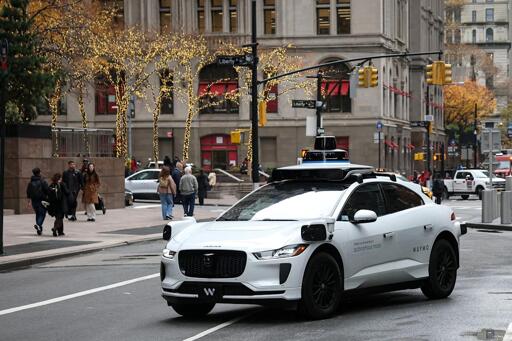
Several of Waymo’s autonomous vehicles were seen stuck in the middle of San Francisco streets following a significant power outage that took out the city’s traffic lights. Waymo responded to the power outage by suspending its ride-hailing services in the city, but images and videos on social media showed the self-driving taxis stopped at intersections with hazard lights on.
“We have temporarily suspended our ride-hailing services in the San Francisco Bay Area due to the widespread power outage,” Suzanne Philion, a spokesperson for Waymo, told Engadget in an email. “Our teams are working diligently and in close coordination with city officials, and we are hopeful to bring our services back online soon.”
It wasn’t a cloud failure. The self driving cars are highly dependent on traffic lights being red/yellow/green. With the signals inoperative the cars don’t know what to do. Even if there were police officers directing traffic at intersections, the cars aren’t programmed to recognize & respond to them.
That by itself ought to automatically disqualify any such driverless car for use on public roads.
Even ignoring the police officers, aren’t there clear rules for what to do when traffic lights are turned off?
In Germany, an inactive traffic light means that traffic control reverts to any present traffic signs (stop/yield/priority road). If none are present, the default rules for entering an intersection apply (which in Germany are to yield to any traffic coming from your right).
All of those rules already must be implemented for autonomous driving so why the hell couldn’t they implement a hierarchy?
Weird. If that’s the case, how hasn’t this been more of an issue? This isn’t the first time a light has gone out in SF.
And then on top of that, since a ton of people were then connecting to cell service since their WiFi was out, that meant the cell towers were so overloaded they couldn’t send data to operators that the car requires to be started up again, like multiple camera feeds, a 3d scan of the surroundings, etc.
So there’s a lot of assumptions in this thread, but this specifically is just wrong. The cars do not need to have a constant connection with camera feeds and logic flowing to and from hq. They do nearly all processing on the vehicle, and comms to hq is used for location, status, etc but absolutely does not require the logic sent remotely to actually drive the vehicle.
I can’t list sources because of an NDA (I am the source, nobody else is going to back me up), but I’ve seen the systems, I’ve been inside the AZ waymo hq, seem how hq interacts with the vehicles, the location and size of the compute system that does all the logic, I’ve seen how it works way beyond what the media has seen. I’ve rode in one of their test mules, with techs answering a slew of questions that I posed, and asked about the hardware and debug/test software that the public simply can’t see.
I’m not sure why this happened - most people spouting this or that are just wrong. As of a decade ago, the cars were capable of handling failed stoplight and situations like that. They are also capable of being remotely controlled - someone above claimed otherwise, but they absolutely can be. Only in situations where the car is stuck or acting erratically (you call the hq via a button in the car, and they can pull up the vehicle and see everything about it, and if necessary, take control).
Either someone broke something regarding this situation (handling failed lights, etc) that was previously working, and this is the first time the issue has shown itself… or the power outage hit their ca hq, and when the cars couldn’t stay connected for X amount of time, they went to failsafe mode. I’m leaning heavily towards the latter - there is very little data flowing between vehicles and hq (unless remotely diagnosing or controlling), but there is a bit (location, speed, status…), and maybe when hq went offline for a few minutes, it’s a safety thing (think about someone trying to steal a Waymo car, for example, by trying to sever the connection, physically blocking it in, etc). That’s just speculation though, but it’s all I can think of.
My speculation is a safety feature working as intended.
As someone familiar with automation and machine learning, I certainly hope most of the processing is happening in device. It’s just not realistic to have a cloud driven car.
But it makes more sense to have a dead mans switch on the safety operator. “If you can’t connect to the safety operator, you can’t go”