Researchers from the University of Cambridge and GlitterinTech, a startup founded by the same research group, have unveiled a fundamentally new type of optical spectrometer that delivers laboratory-grade precision in a device small enough to be embedded in portable and wearable technologies. By rethinking how spectra are measured and processed, the team has demonstrated a spectrometer costing only around $10, operating at a centimeter scale, and capable of applications ranging from industrial quality control to real-time health care monitoring.


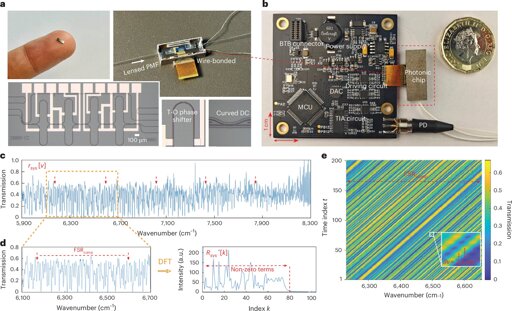
The writing in the linked article is a little weird, as others have pointed out. However the journal publication is very cool. If this is reproducible, it’ll likely have a noticeable impact over the next 10 years or so. We won’t see $10 spectrometers, but we might see handheld ones in a similar format to the cheap IR cameras.
Here’s the link for anyone interested.
https://www.nature.com/articles/s41566-026-01891-6
If you’re familiar with this kind of stuff, do you think this could lead to cheaper and smaller hyperspectral cameras?
This technology isn’t for generating images but for measuring what frequencies are present in light.
I’m not 100% sure on the specifics, but it sounds like they are using some mathematical properties of fourier transformations to either broaden the frequency response of sensors or simplify the math required to get the final result.
Hyperspectral cameras are designed to generate images from a matrix of light sensors.
This could maybe lead to spectral cameras (as in a camera where each pixel is the spectrum of light in that pixel), which could then generate images of arbitrary spectra, but I suspect that this sensor is still quite a bit larger than the sensors used in digital cameras these days. Even a hyperspectral camera doesn’t really care about what frequencies it measures, it’s just able to detect differences in amplitude at those frequencies and either doesn’t detect outside of that range or has something filtering the light outside of the range before it reaches the sensors.