

1·
6 days agoThank you! Let me know when you get to it. Always open to hear feedback :)
Thank you! Let me know when you get to it. Always open to hear feedback :)
I understand the concern, but MIT has been very intentional to signal the opposite of what you’re worried about. Paperweight runs fully local. Everything works without any back-end or external services. No one can turn this into some paid SaaS to lock features. It already passes the walk-away test and there’s literally nothing to rug and if the project ever goes into a direction you don’t like you don’t lose access or need anyone’s permission.
While GPL theoretically gives you the same opportunity, I feel like it adds some overhead and potentially locks out genuine contributors.
And especially in the age of AI, code is cheap and if someone wants to build a closed Paperweight, the license is not going to stop them.
The App does help you find what data is shared where, but it is indeed based on the data that is shared over email. Which might not include everything, no. But at least it’ll flag the account instead of being some, old account you forgot about.
I know a lot of companies tend to push you to their forms. Which can be helpful for identification, but you don’t have to follow they process. They’re legally obliged to honor requests via email. The app helps you to track them.
I know Github has its flaws, but using for convenience. Not sure how it impacts the App.
Currently at around 280 Github stars and a few contributors. And here’s some more context https://lemmy.ml/post/47559040
I understand you don’t want to take my word for it, but I can assure you the App uses no external services.
Migrating 20+ year inboxes are definitely a pain. I did it a while ago, and tried to stay on top of it better since. As said below, never fully delete an old-email address. Others might be able to hijack the old account and impersonate you. Use a custom domain so you can easily switch providers if ever needed. A catch-all or aliases work great, but check if it allows to send from it. Especially for verification (e.g. delete an account) you often need to verify or send from the origin email. I stopped unique addresses per website. I’d keep a few just to separate “official” things, from general use/registration, and stuff I don’t trust.
Paperweight sort of gives you an overview of services, but I’d recommend to do this more gradually otherwise you’d probably go crazy. Whenever you sign up, check your email and change to one of the addresses above. After a year or so, you likely have done most important once (that at least require you to login). You could probably just keep the others as is, with your old email for legacy. But only use the new address(es) moving forward.
Hope that helps!
Agree, and I’ll consider. I know its not a great reason, but Github is still too convenient as it also runs CI/CD, and other actions/workflows. I don’t believe its possible with Codeberg?
That’s fair. I’m still experimenting with pricing/licensing models, so appreciate the feedback. To be clear, the license grants you permanent use and at least all updates, including V1 which is documented on Github. Not making any promises what’s after yet, because in all honesty. I don’t know yet what a V2 or other features would look like. Just trying to be transparent on what you’re getting right now + upcoming updates. We’ll see what’s after, and open to ideas
No plans on a Docker compose for now, but feel free to submit an issue. RE licensing, there’s some discussion on it below. FOSS describes software licensing, which is all MIT. There are 2 features “gated” behind a license check, which supports development and gives the convenience of a ready-made build (which have costs involved). But all code is open, and you’re welcome to modify/fork out if you prefer to run your own.
Thank you! Appreciate that. Would love to hear your thoughts when you get to spin it up!
Sure, my original thought was that GPLv3 would ensure that contributions/forks would at least remain open. Which seems novel, but 1) Realistically I probably wouldn’t have any way to enforce it, and 2) GPL is terrible for businesses, and might block genuine contributors. E.g. a company who wants to write an internal plugin/extension, would be forced to open-source it under GPL, which might not be feasible. So they either don’t use/contribute at all, or might build it themselves from scratch. Especially with AI these days, code is cheap and its easy to “reproduce” entire codebases in a fraction of the time. MIT just simplifies, and makes it fully permissive for genuine users/contributors. Do whatever you want with it (incl. forking out the license check if you want)
Sure, like most projects I use AI assistance a lot for most of my work these days, ngl. Its helps me plan, research and code new ideas/features and makes a lot of my work easier. Having said that, I fully understand and share people’s feelings about yolo, vibe-coded slop. I’ve been a software engineer for 20+ years. AI helps with a lot, but also feels like the honeymoon phase is wearing off actually. It doesn’t give me the joy of building stuff. I still test, review and ship everything myself. You can check my Github history that I’ve been doing this way before recent AI hype.
Either way, the idea and execution is 100% me. I’m building something I want, use, and care about myself. Whether I’ve used AI is not too relevant, imo. It’s that all alternatives have been caught selling your data (Unroll), heavily rely their centralized services or require you to give up your data in order to remove it. Which is ironic. Paperweight is the only tool I’m aware of that does this entirely local and is open-source.
P.S if its quality you’re worried about, Paperweight has been audited through Google’s CASA assessment and Apple’s developer verification (admittedly, not a super high bar).
Hi, nice to see you here! Would love to hear your thoughts. And thanks for standing up in the comments. Much appreciated :)
Correct. But all code is there, so you can fork them out yourself if you want.
Thanks for the reply! And good question. Yes, all code, including all paid features are open source too. Not just open core. There’s nothing proprietary. Some of the paid features are gated behind a license check, but it’s all part of the same repo and MIT licensed. It’s all there to inspect or fork if you want. The perpetual license however helps support development and gives the convenience of a ready-made build.
We actually moved recently from GPLv3 to MIT to be fully permissive.
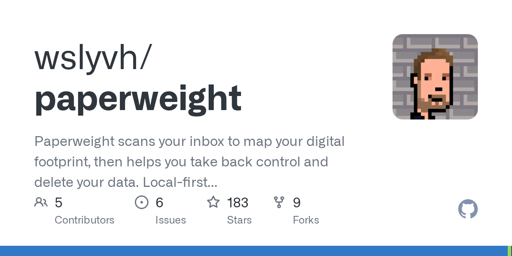

I probably don’t. I know copyleft vs permissive can be heated debates and I don’t have a very strong opinion. My decision and reasoning is mostly based/aligned with https://shazow.net/posts/permissive-vs-copyleft/
At the current stage, and as solo dev, I don’t believe that either licensing is realistically going to have any meaningful difference. There are plenty of cases where copyleft didn’t prevent capture. And permissive projects that thrived above corporate versions.
But I’m curious to learn and appreciate the feedback. Can you elaborate? What’s the main concern. What assurances, or protections do you hope to get from GPL? Is it about using the project, or contributing to the project?