This makes me wonder what is better - underwater DCs heating the oceans, or above water ones with all the pollution creating and water sucking cooling instead. Part of me thinks the underwater one might be better.
The issue with climate change was never with “heat production”. It’s always been the generation of heat trapping chemicals. The sun sends a stupid amount of energy our way. Generally the earth radiates almost the same amount back out into space, with a minor amount captured by various things, like photosynthesis.
Pollution alters that equation and causes more energy from the sun to get trapped in the atmosphere. That’s the problem. We could never generate as much energy as the sun (even the tiny amount that hits the earth), but we can definitely alter the atmosphere to trap more and more of that heat.
Also, the ocean is a MASSIVE heat sink. I saw someone work out the calculations recently, I don’t remember the numbers, but the conclusion was that we’d never measure a notable increase in ocean temps if we housed every datacentre in existence in the ocean. The sun hitting the ocean every day dumps more energy into the ocean directly than we’d ever be able to manage.
If you take local temperatures of the ocean at different latitudes, they won’t all be the mean temperature of the ocean. It isn’t a single massive heat sink.
But that’s true no matter where you put the data center. If you have to dump the waste heat somewhere, the high density and specific heat of water is a better heatsink than the air around us.
It’s also likely to impact more living things (plankton, seaweed, fish, reefs) in the same space, given the locations likely to be considered, either due to biodensity or increased heat spread because of high water conductivity.
I think you have to look at the actual orders of magnitude difference in raising the temperature of water versus air. The Arizona story you linked is about a study that found up to +4°F (+2.2°C) temperatures in air.
The same amount of heat, spread across the same volume of water moving at the same speeds, would only raise that water by 1/830 as much, for a +0.0048°F (+0.0027°C) 1/3300 as much, for a +0.0012°F/+0.00067°C temperature change across the same area/volume.
(I got to 830 by taking the specific heat of dry air of approx 1 J/g K at room temperature and regular atmospheric pressure and 1.22 kg/m^3, versus water’s 4.184 J/g K and 1000 kg/m^3).
(Edit: I fucked my math. Water has approximately 3300 times the heat capacity as air, per unit volume, and I just looked it up directly).
The higher conductivity of water might be offset by the higher convection potential of air (because air responds to temperature changes with differences in density/pressure, which creates wind in itself), so that the heat will spread through either medium relatively quickly and therefore dissipate very quickly with distance to the source.
I just don’t see a world where a data center raises the water by even 1°C, even locally.
That’s true, but water is so much more effective at absorbing heat than air, the effect will be negligible. It takes about 4.2 megajoules to raise one cubic meter of water 1 degree C. That energy would raise over 3 cubic KILOMETERS of air 1 degree C.
Even putting data centers at the bottom of large lakes would be unlikely to have an effect. It will not be percetable in the ocean. Regarding temperature anyway, other factors are worth considering.
The total effect is negligible, but even with high conductivity, local impact could be destructive enough. Even with an infinitely large copper pan, I wouldn’t put my hand on the part that’s on a stove’s burner.
That’s true too, but the impact will be very very local. Really, we just need to have fewer data centers, but at least by putting them in the ocean we are only impactfully warming probably less than 300 cubic meters of water instead of an entire neighborhood, or depleting groundwater to cool the damn things. Seems like the least harmful way to cool them, if we’re going to have them.
This is slightly off topic but when our local NPP was operational the lake that they used as heatsink would never freeze over even in the coldest winters. Of course it’s not a huge lake.


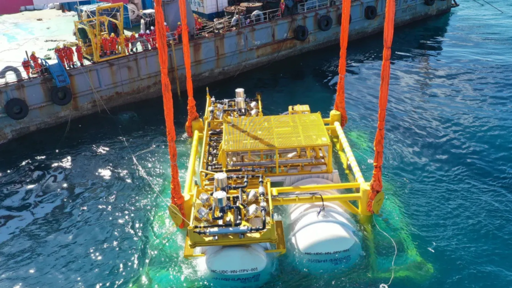
This makes me wonder what is better - underwater DCs heating the oceans, or above water ones with all the pollution creating and water sucking cooling instead. Part of me thinks the underwater one might be better.
The issue with climate change was never with “heat production”. It’s always been the generation of heat trapping chemicals. The sun sends a stupid amount of energy our way. Generally the earth radiates almost the same amount back out into space, with a minor amount captured by various things, like photosynthesis.
Pollution alters that equation and causes more energy from the sun to get trapped in the atmosphere. That’s the problem. We could never generate as much energy as the sun (even the tiny amount that hits the earth), but we can definitely alter the atmosphere to trap more and more of that heat.
Also, the ocean is a MASSIVE heat sink. I saw someone work out the calculations recently, I don’t remember the numbers, but the conclusion was that we’d never measure a notable increase in ocean temps if we housed every datacentre in existence in the ocean. The sun hitting the ocean every day dumps more energy into the ocean directly than we’d ever be able to manage.
It all comes down to pollution.
If you take local temperatures of the ocean at different latitudes, they won’t all be the mean temperature of the ocean. It isn’t a single massive heat sink.
Data centers raise nearby temperatures by up to 4 degrees in Phoenix
But that’s true no matter where you put the data center. If you have to dump the waste heat somewhere, the high density and specific heat of water is a better heatsink than the air around us.
It’s also likely to impact more living things (plankton, seaweed, fish, reefs) in the same space, given the locations likely to be considered, either due to biodensity or increased heat spread because of high water conductivity.
I think you have to look at the actual orders of magnitude difference in raising the temperature of water versus air. The Arizona story you linked is about a study that found up to +4°F (+2.2°C) temperatures in air.
The same amount of heat, spread across the same volume of water moving at the same speeds, would only raise that water by
1/830 as much, for a +0.0048°F (+0.0027°C)1/3300 as much, for a +0.0012°F/+0.00067°C temperature change across the same area/volume.(I got to 830 by taking the specific heat of dry air of approx 1 J/g K at room temperature and regular atmospheric pressure and 1.22 kg/m^3, versus water’s 4.184 J/g K and 1000 kg/m^3).(Edit: I fucked my math. Water has approximately 3300 times the heat capacity as air, per unit volume, and I just looked it up directly).
The higher conductivity of water might be offset by the higher convection potential of air (because air responds to temperature changes with differences in density/pressure, which creates wind in itself), so that the heat will spread through either medium relatively quickly and therefore dissipate very quickly with distance to the source.
I just don’t see a world where a data center raises the water by even 1°C, even locally.
That’s true, but water is so much more effective at absorbing heat than air, the effect will be negligible. It takes about 4.2 megajoules to raise one cubic meter of water 1 degree C. That energy would raise over 3 cubic KILOMETERS of air 1 degree C.
Even putting data centers at the bottom of large lakes would be unlikely to have an effect. It will not be percetable in the ocean. Regarding temperature anyway, other factors are worth considering.
The total effect is negligible, but even with high conductivity, local impact could be destructive enough. Even with an infinitely large copper pan, I wouldn’t put my hand on the part that’s on a stove’s burner.
That’s true too, but the impact will be very very local. Really, we just need to have fewer data centers, but at least by putting them in the ocean we are only impactfully warming probably less than 300 cubic meters of water instead of an entire neighborhood, or depleting groundwater to cool the damn things. Seems like the least harmful way to cool them, if we’re going to have them.
This is slightly off topic but when our local NPP was operational the lake that they used as heatsink would never freeze over even in the coldest winters. Of course it’s not a huge lake.
I don’t believe they meant it that way. At that scale, literally nothing will be a uniform temperature.
True, but that’s my point: there will be local impacts that aren’t evenly distributed.