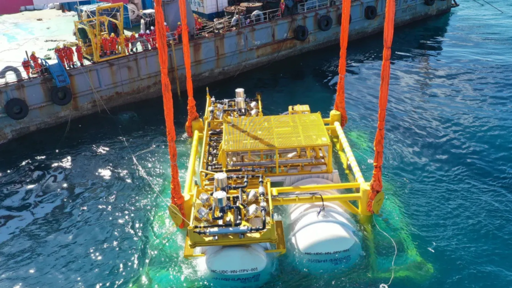
Still, FUCK AI.
Don’t you see? This is what we needed, a way for AI to fuck over fish too.
Hasnt microsoft been doing offshore datacenters for nearly 15 years? The one off the shore of the UK was almost certainly majority wind powered.
Great, let’s boil the ocean faster.
Yeah, great because ocean habitat already straining from warming oceans are going to love having AI that produces nothing but hallucinations and pron heat up the waters even more.
Computers and electronics love salt water
There is a complex system of tubes
So this is how we boil the oceans? With fucking underwater AI data centers. Definitely not on my bingo card
No? It’s powered by wind energy. Wind is created by heat from the sun. If you capture and use the energy or not it still stays in earth’s system. This is about as green as computing can get.
Hmm so the sun is chucking a bunch of heat into the earth right, what is happening to that heat? Why not get some use out of that energy before it radiates away into space? This is a good thing, yes bad things exist, but this one is good.
Either I’m misunderstanding you, or you’re misunderstanding the situation. They are not pulling heat from the ocean, they are adding to it. And unfortunately that heat is doing a bad job of raidiating into space.
In thermodynamics, this is the heat goes in, heat goes out. Also temperature higher, more heat goes out.
And CovfefeKills is right. Heat from the sun is orders of magnitude higher than a little bitty data centre. And that heat gets re-radiated to space. It’s all balanced. Except for when you put more heat absorbing gases into the atmosphere which include increasing levels of evaporating water. All to power and cool current data centres.
The Earth is constantly bombarded by the sun, why doesn’t the Earth just continuously heat up? Because it radiates heat away into space. So heat itself isn’t the problem okay It just goes off into space. The problems come from the balance of absorded energy vs. radiated energy which is why oil is such a bad thing at such a large scale, it’s ancient sun energy that can’t be radiated fast enough. And fucking with our enviroment and atmosphere which has degraded the ability to radiate energy.
Taking daily solar wind energy and converting it into heat energy in the ocean itself is no problem, the problem is if the ocean cannot radiate away that heat due to fucking with the atmosphere. And by taking more solar energy and converting it to useful energy we reduce the amount of fucking with the atmosphere. It’s a good thing.
They’re using the ocean to cool the computers. This heats the water.
The wind energy used would eventually dissipate into heat anyway, this just puts AI in the middle.
In general: all computers turn electricity into heat. After that you get to deal with the heat, which will ironically generate even more heat (fans, pumps, etc.). This is Power Usage Effectiveness (PUE). A shitty datacenter might spend over 30% of the energy on cooling. Of course, any compute will end up heating up things, so moving the heat away efficiently is a huge deal.
I think dunkin a datacenter in water and powering it with wind is probably about as energy efficient as you can possibly get without moving into heat reuse (which we should):
- Sea water is cold, so the temperature differential is large. This means efficient and cheap heat transfer.
- Sea water moves, so you don’t need to actively pump it away or rely on convection to move the heat away.
Now, the more efficient way to deal with this is that modern liquid cooled hardware can go rather hot. Hot enough to do something with the waste heat. We can heat a campus, contribute to district cooling, etc. This is of course mostly relevant in cold climates, and often only during winter.
This design is probably a reasonably good idea from an energy efficiency standpoint. From an ecological standpoint, probably not, but I’m not qualified to answer that question.
We should do something better with our limited resources than generating AI-slop, but there are plenty of other more legitimate compute uses (like climate research) that could benefit from similar setups.
Okay Patrick
I think you got downvoted because of the misunderstanding of the heat you are referring to which is heat = wind power and light = solar power
I am terrible at explaining things and probably deserve the downvotes. If I thought they mattered I might try harder.
But I have noticed if you gap some context the Fediverse/Lemmy exposes itself. So in this instance the they need to be spoon fed “energy is energy” yea no thanks. This stopped being about changing their opinion and instead about reinforcing to myself that these NPC’s cannot be allowed to inform my opinion.
Some also hate my explanation too, they probably think if you put heat into water, it stays there for perpetuity.
Deserts are a great example of what happens when there’s barely any (greenhouse gas) water in the atmosphere.
You say you’re bad at explaining things, but I think you did a decent job explaining Lemmy culture. If you go against certain dogma — even if you’re right — you’ll catch a lot of unexplained, seemingly-irrational, downvotes.
I’m not much of a social media guy, so when I first joined Lemmy, I found this confusing. I suppose I still do, but I just accept it and move on. That’s just how it is here.
I’d bet that this comment will be mostly downvoted. However, after posting it, I will spend exactly zero seconds worrying or wondering about it 🙂
I wonder what “wind powered” means?
Oh are you confused because you didn’t know all energy is from the sun? Yea the wind is powered by the sun fun right?
Geothermal energy isn’t from the sun
…nor are fossil fuels derived from chemoautotrophic biomes…
Yea I could have been more specific.
So you are that dumb.
Okay Patrick.
So salt water can be used!? 🤔
You can also just use air
If you have access to it. Unfortunately, most of them are setting up in drought ridden deserts. They’ll be fighting Nestlé for the last drops pretty quickly.
What will this do to the local ocean ecosystems?
China doesn’t care. The US doesn’t care.
People care… But who are we? What do we matter?
I think the dissipation must be extremely efficient. They might have instruments in place to monitor the effects (?) but I’d say the water temperature must be that of the surrouding ocean,… at worst something like 1m away from the radiators? I’m not a physicist. Perhaps the heightened temperature can even provide a hook of sorts for some species? like a weak hydrothermal vent? could be interesting to study.
In any case, the one thing that’s going to tear us apart is water availability. I think it’s smart to do away with that requirement for a data center.
Fish soup, coming right up.
Okay, who had the bright idea of boiling the ocean to make soup?
God, the insane amount of energy it would take to even remotely measure a difference in the ocean water is astronomical. You might be able to cause some small impact in a relatively small radius that could impact wildlife, but I feel like there are open enough areas that not much would be impacted in the area.
Let’s boil the ocean everyone.
We… We’re already doing that.
Sorry. :/
I didn’t know you’d find out this way.
But now we’re doing it more efficiently!
How long until someone has the idea to put them near already-melting glaciers
I got some future waterfront property in the Appalachian Mountains.
This makes me wonder what is better - underwater DCs heating the oceans, or above water ones with all the pollution creating and water sucking cooling instead. Part of me thinks the underwater one might be better.
The issue with climate change was never with “heat production”. It’s always been the generation of heat trapping chemicals. The sun sends a stupid amount of energy our way. Generally the earth radiates almost the same amount back out into space, with a minor amount captured by various things, like photosynthesis.
Pollution alters that equation and causes more energy from the sun to get trapped in the atmosphere. That’s the problem. We could never generate as much energy as the sun (even the tiny amount that hits the earth), but we can definitely alter the atmosphere to trap more and more of that heat.
Also, the ocean is a MASSIVE heat sink. I saw someone work out the calculations recently, I don’t remember the numbers, but the conclusion was that we’d never measure a notable increase in ocean temps if we housed every datacentre in existence in the ocean. The sun hitting the ocean every day dumps more energy into the ocean directly than we’d ever be able to manage.
It all comes down to pollution.
If you take local temperatures of the ocean at different latitudes, they won’t all be the mean temperature of the ocean. It isn’t a single massive heat sink.
Data centers raise nearby temperatures by up to 4 degrees in Phoenix
But that’s true no matter where you put the data center. If you have to dump the waste heat somewhere, the high density and specific heat of water is a better heatsink than the air around us.
It’s also likely to impact more living things (plankton, seaweed, fish, reefs) in the same space, given the locations likely to be considered, either due to biodensity or increased heat spread because of high water conductivity.
That’s true, but water is so much more effective at absorbing heat than air, the effect will be negligible. It takes about 4.2 megajoules to raise one cubic meter of water 1 degree C. That energy would raise over 3 cubic KILOMETERS of air 1 degree C.
Even putting data centers at the bottom of large lakes would be unlikely to have an effect. It will not be percetable in the ocean. Regarding temperature anyway, other factors are worth considering.
The total effect is negligible, but even with high conductivity, local impact could be destructive enough. Even with an infinitely large copper pan, I wouldn’t put my hand on the part that’s on a stove’s burner.
This is slightly off topic but when our local NPP was operational the lake that they used as heatsink would never freeze over even in the coldest winters. Of course it’s not a huge lake.
I don’t believe they meant it that way. At that scale, literally nothing will be a uniform temperature.
True, but that’s my point: there will be local impacts that aren’t evenly distributed.
I wonder how many sq km of data centers it would take to increase the temp of the ocean by 1 degree.
I would guess it would take over a million square km of uninterrupted data center to raise the average ocean temp 1 degree C
This page says the ocean is about 352,670,000,000,000,000,000 gallons, which is about 1.3 x 10^21 liters, and each liter is a kg of water (yeah, yeah, the dissolved salt adds some mass but I don’t think it adds sufficient thermal mass to make a difference). It takes 4.184 kilojoules to raise 1kg of liquid water 1°C, and 1 joule is 2.778 x 10^-4 wh.
So that’s 1.55 x 10^18 watt hours, or 1,550,000 TWh.
Global electricity consumption is about 30,000 TWh per year, so if you use the entire world’s electricity consumption for 51 years you’d raise the oceans’ temperature by 1°C.
Or if you take global data center power capacity of about 125 GW, and ran them at full power 24/7, you’d be producing about 10.8 TWh per day or 3944 TWh per year. It’d take about 393 years of the world’s data centers to raise the ocean by 1°C.
Just goes to show that much more of the energy heating up our world and our oceans is coming from the sun heating up the planet and the planet failing to radiate it out past our greenhouse blanket, not from the actual heating of our atmosphere from our own energy sources.

So if data centers continue to be built then we’re pretty much lining up another climate apocalypse behind the one we’re currently in.
This really is some great filter shit.
Instead of drilling into the core we’re just going to get boiled alive. Pretty poetic for a garbage system like capalitism.
But … It’s China. It’s not jst capitalism, it’s human greed and fear.
But … It’s
Chinahumanity. It’s not jst capitalism, it’s human greed and fearFTFY
It’s just capitalism.
The only difference is that their capitalism is controlled by the state instead of an international oligarchy of billionaires.
Sure, not like US or Europe.
Parts of the ocean are colder and several species are having issues locating new spawning grounds.
I remember hearing of a corodile species or something that recovered due to a new power plant discharging warm water.
Overall ocean temps rising is a problem, but the real problem is becoming more uniform temps.
Cold spots are getting warmer. But warm spots are getting colder too. And especially for fish and reptiles. They need warm spots to spawn.
Ecologically speaking this is likely to be a good thing and within a couple years this could be a very important habitat that people are talking about and acting shocked about.
Even tho logically it’s obvious
How many AI datacenters will it take to boil the ocean?
If it’s being powered by wind, it’s not adding additional energy to the environment, at all. It all comes down to conservation of energy, and no chemical changes are occurring.
Electrical energy is being generated by harvesting kinetic energy in the wind, that’s essentially just moving energy, converting it from one form to another. Energy can be swapped and converted around, but in the end, it almost always ends up turning into heat or light.
That wind, one way or another was going to convert its energy into heat. Most often it does that by convection, causing water vapor in the air to change state, after condensing, the now warmer water release its heat into the ocean when it falls as rain.
Turning a wind turbine to generate electricity, to run computers, is a much more elaborate route to take, but the result is the same. The wind is moving slower, a lower energy state, but the ocean is warmer, a higher energy state. It all evens out.
Edit: I just realized, that sometimes that kinetic energy from wind contributes to storms and sometimes those storms generate lightning, and while most of the energy from lightning does turn into heat, some of that energy generates light, and some of that light shoots out into space (actually escaping the earth). So probably, higher wind speeds do result in cooling the earth a very little bit (but it’s likely negligible)
Well part of the wind also comes from the solar activity warming parts of the earth up and thus changing the pressures around so it’s not an entirely closed system
It would probably take more energy than we can harvest on earth, considering the sunlight and geothermal energy doesn’t boil it currently.
I could see it affecting the temperature on local scales, such as the area immediately around the data center.
There are a number of 6-8GWe nuclear plants that dump 15+GW into the nearby sea (or in the case of Bruce, into Lake Huron). I don’t see it being much of an issue. Better than virtually any other cooling option.
The issues are maintenance, energy source, and equipment supply.
The plants on the lakes so monitor the water temp so they don’t affect the ecosystem during the warmer seasons still.
But I doubt the one in NB had to worry about that when more water flows by it than all the rivers in the world combined.
But yes, much better source of cooling at the cost of maintenance and equipment. Just like tidal power but with fewer moving parts.
The plants on the lakes so monitor the water temp so they don’t affect the ecosystem during the warmer seasons still.
Yeah, but look at the magnitudes of the heat units involved. Modern nuclear plants generate 0.6-4.5 GW at around 30% thermal efficiency (so they generate between 2-15GW of heat). These underwater data centers are looking at 25 MW (0.025 GW) while surrounded by water in 5 of the 6 3-dimensional directions.
There is some risk to local ecosystems, but we’re literally talking 2 or more orders of magnitude difference compared to nuclear plants or other thermal plants.
I don’t think people mean literally boil the ocean. Just increasing it by few Celsius degrees can be world ending.
The specific heat capacity of water is 4200J/kg. Raising the temperature of ocean water by quite a few degrees is also very improbable.
That’s true, but I still don’t think we can raise ocean temperatures through direct cooling and renewable sources the way that the greenhouse effect can. Water can absorb a lot of heat energy without changing temperature, and that is why regions close to oceans have a more temperate climate.
While I don’t have enough knowledge in this field to be making any definitive statements, my logic is as follows:
- outside of nuclear fission/fusion reactions, heat energy on the earth’s surface comes from either the sun or molten rock in the core
- that energy is responsible for everything that happens on earth, including wind energy
So we would need to get energy from off planet, use nuclear fission/fusion, or cover enough of the land area in wind and solar farms in order to redirect the sun’s energy over to the oceans.
I think the bigger concern, when it comes to heating the ocean, is that manufacturing, construction, and transport related to the data centers still releases a lot of greenhouse gases. Those gases trap the sun’s energy within our atmosphere and that WILL heat up the earth. Way more than direct cooling using ocean water.
Burning Oil, coal and natural gas generates heat energy and is generally out of the energy loop trapped in the earth before extraction…
I’m a scuba diver and you can definitely harm regions of ocean with water pumps. It’s already happening in place where nuclear is being cooled. It’s already happening in ship yards.
It’s hard to speculate how it would happen at scale though because ocean science is real fucking hard and each location is vastly different. In populated places the damage would be very noticeable if not eventually catastrophic as ocean issues compound real fast as the ecosystem is much more fluid.
That being said I imagine there would be ways to deploy this safely (ocean is big, lots of boring dead space) but I dont have trust in us to find this way.
the signs they intend to put on the side that said the fucked the fish’s mother seems needlessly antagonistic tho
If every data centre was passively cooled in the ocean it wouldn’t change temps by even 0.01 degrees. The Sun blasts an entire half of the planet with an absurd amount of energy every day. Energy, which technically originated from the sun, is just converted and being utilized to do work.
Not the same thing. The sun doesn’t concentrate the power in already hifhly populated gulfs and bays where these would be. We’re not building something in the middle of Atlantic Ocean.
Good point, although on the local scale you mention, wildlife could still be impacted. Hopefully, the overall impact on the ecosystem will be monitored and studied before expanding these data centers more broadly.
Around (4 to 6) * 10^(26 to 27) J total
1 gigawatt is 10^9 J/s (so around 130 billion years to reach the above.) For a terawatt that’s 130 million years. For a petawatt 130,000 years. For an exawatt about 130 years…
Note: the sun bathes Earth with around 170,000 TW (0.17 exawatts) of energy. That’s about 700-800 years if you could make the oceans sink all that sun energy. Again, this isn’t the total output of the Sun but just what impacts Earth directly.
Well, if the energy comes from solar on the thingy, then it’s probably going to cool the ocean, could be similar with wind.
That’s a good point. Maybe not cool, but it would warm the water less.
(I’m guessing solar cells reflect less energy back into space than water, since they’re specifically designed not to.)I don’t know how to objectively figure this out, but solar panels only convert energy from radiation down to far infrared of 1100nm. Water can absorb longer wavelengths, but solar output has less and less energy output at these wavelengths. However, the mystery is whether or not the panels themselves absorb or reflect such far infrared energy. I’m torn between “it might be the same” and “I’m wrong”
40…2…ob…viously…
So when do we start putting big ice cubes in the ocean?
(Really this at least makes more sense then land slop centers, still silly)
they might move them to antartica or the artic.
The ocean is already warming, and these guys want to heat it up even more? Didn’t these guys watch Day After Tomorrow? Because this is how we start a new ice age.
sudo systemctl poweroffOH FUCK I was in an ssh session!
*Puts on scuba gearDeep sea
welderadmin.Most stressful job imaginable
At least you won’t have to deal with end-users on site.
Hopefully that server has IPMI.