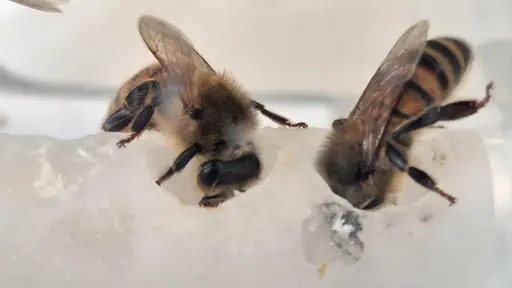
Scientists have developed a breakthrough “superfood” for honeybees by engineering yeast to produce the essential nutrients normally found in pollen. In controlled trials, colonies fed this specially designed diet produced up to 15 times more young, showing a dramatic boost in reproduction and overall health. As climate change and modern agriculture reduce the availability of natural pollen, this innovation could offer a practical way to support struggling bee populations.


Seems easier than engineering edible yeast to get them the sterols they need.
But you see they can sell this! Can’t sell “fallow fields”…
Fellows can sell seeds for fallow fields, my friend. never fear for they will forage, and be fine.
V, is that you?
Didn’t use fertile or follow or falter. Fine folly.
Frankly, foul folly feels fitter.
Yes well known fact we shouldn’t research any technology to reverse the collapse of our biosphere or to alleviate climate change. Wouldn’t want anyone being able to sell that tech. Best we just turn off the lights and plant some flowers.
I love planting some flowers, but we’re going to need technology to undo the mess we created.
“They” being the University of Oxford?
Plenty of companies have been founded by former university researchers based on discoveries they’ve made while at said universities. Seems like nothing prevents those folks from patenting the newfound methods for themselves.
Or, they will license the technology to a big manufacturer. Seeing as the University of Oxford is probably ill-equipped to produce industrial amounts of yeast.
You would be surprised, yeast vats and breweries have a ton of overlap, IE pretty cheap tanks and reasonably standard infrastructure. Most universities with a biology research wing are going to have a few bio-reactors, and while they may not be able to produce the feed itself industrially, they can easily breed starters to sell to places like breweries and companies that already produce yeast at massive scale.
That’s it! I’m calling my beer brewing vessels ‘bio-reactors’! No more carboys for me!
I mean, yeah. What did you think a bio-reactor was but a really fancy carboy?
There is some nuance in amenities, but at the end of the day it is a temperature-controlled and sterile environment for microbial growth to take place.
I use glass
carboysbio-reactors, and also have a couple stainless steel cone bottom bio-reactors. The first, not so fancy; temperature control is accomplished by moving them to a room that has something approximating the apppropriate temp. The second has a tap near the bottom, and a hole for an airlock on top. I do have a couple heat belts, if I needed to raise temp, as they came cheap from a kombucha operation that was shutting down. Hmm, for that matter I do have that instipot for making natto or yogurt, it’s a bioreactor too, now. Come to think of it, so is this silly sphere in space we’re conversing upon. Cheers!But Brawndo has the electrolites that plants crave!
Just in case the joke is too far of a stretch to make the connection, what I’m saying is the obvious simple solution isn’t profitable.
They’d rather sell you a solution that doesn’t actually work, then give you a solution that works that they can’t make profit on.
So Brawndo for bees too? Done!
Who is “they” in this case
It also doesn’t degrade ecosystems further.
Bees aren’t just the domesticated honey bees.
Yeah, I found that pretty weird, too. Not only that, but you can’t get that yeast for the next two years. Your method works yesterday haha.
In the end, it probably isn’t easier at all. Once the yeast is created, yeast is dirt cheap and easy as hell to grow, and wouldn’t require managing a field of wildflowers that are going to drop seeds for the following year when you intend to plant crops there. I’m not saying it’s a good or ethical choice, but the yeast definitely has the potential to be easier and cheaper