Love how people in this post believe THE brake manufacturing company, single supplier for virtually all competition-level vehicles, not to mention billions of road vehicles, are a bunch of dumbasses who can’t design a different version of their MAIN PRODUCT.
Love how people are going on about regenerative brakes when this is simply deleting the hydraulic lines for wires and actuators in a normal friction brake system.
I don’t have an issue with a new system per se. This gives me pause though.
The announcement was light on details about both the system itself and how its fail-safes are implemented
The system they propose is a brake by wire system that uses electric motors. What happens when you have no power? On an EV this might be moot. What happens after an accident and this system is damaged? I’ve seen plenty of cars start to roll after an accident until the driver applies the brakes. Tesla and their door handles not working is an example of critical systems not working after accidents. I’m mostly curious about what failsafes are in place in this new system. Seems premature for name calling without all the information.
For this system to catch on it needs to either be better than the current systems by a large enough margin, cheaper, or more reliable(aka less warranty claims).
We already have electronic parking brakes on cars. Motor spins the piston in and it has far more clamping force than a drum on hat or lever style caliper or conventional drum. Problem is I live in New England and regularly see them come in with errors because the wires rotted off, while the hydrolics brake lines are still in tact. What’s funny about that is I work in a 4x4 shop where we set up a lot of ram steer systems (hydrolics ram used to steer the wheels) and unless it’s a buggy we set them up in conjunction with ur standard steering linkage (all mechanical links to the knuckles) because not having linkage is considered a safety hazard on the road and illegal. However, it’s totally fine that the cyber truck rear wheels are steered purely via electronics 🙄 I would NEVER trust a pair of 16 gauge wires to tell my brakes to make me stop. I’ve blown the rear brake line in my 40 year old jeep and I just vice grips the rear line shut and drove home with the front brakes only. If a wire rots off at the connector as they always do you need to replace the connector, and odds of u having spares handy and de-pinning tools and extra wire and heat shrink and crimpers etc on board are a lot lower than having a set of leathermans or vice grips or using a rock on the side of the road to ash the line and pinch it shut it before the break.
You realize that one break connection being dead on a wired connection doesn’t mean the whole system takes a crap, right?
If your hydraulic line takes a shit, you’ve gotta clamp it or you eventually don’t have breaks. If an electrical wire disconnects, the electrons don’t fall out, the system throws a warning/error and the other breaks keep working.
First of all, all cars that you’re actually going to drive on the road have two hydraulic brake systems that are almost entirely in parallel. Go look at the master cylinder in your car, there are two lines coming out of the side of it. The way that works is a floating piston; the brake pedal pushes on a piston that applies hydraulic pressure to the first line, and to a piston that floats in the master cylinder which applies pressure to the second line. If either hydraulic system were to fail, that floating piston will bottom out on that side and allow pressure to still be applied to the remaining hydraulic circuit.
If the rear one fails, the floating piston will physically touch the piston attached to the pedal, and be pushed directly. If the forward one fails, it’ll bottom out against the free end of the master cylinder and allow the other to continue working.
Most systems connect one front wheel and one back wheel to each circuit, often in opposite corners of the vehicle. You can lose one line and still have at least partial braking force.
My car has a valve where you might lose some wheels but not all with a line failure. It’s better than nothing. The parking/emergency brake is a manual cable. Don’t know how that is implemented in this new system either.
Most vehicles have some form of dual braking system as a fail safe. Random internet image…
In addition to that a lot of parking brakes if not electronic are all cable and linkage actuated, not that actuating the rear brakes is as useful as the fronts but it’s better than nothing. Or just jam it in 1st or R and kill the engine before u dump the clutch and make the inside parts become outside parts 😂 I’ve been in a truck doing 20 when it windowed the block and I about shit a chicken when all 4 locked up


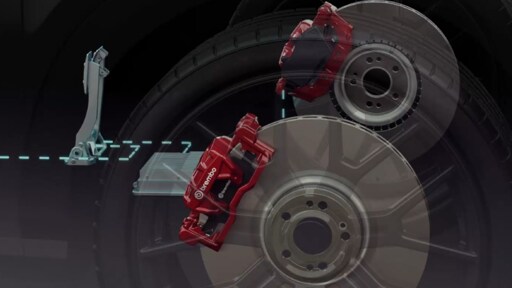
Love how people in this post believe THE brake manufacturing company, single supplier for virtually all competition-level vehicles, not to mention billions of road vehicles, are a bunch of dumbasses who can’t design a different version of their MAIN PRODUCT.
Love how people are going on about regenerative brakes when this is simply deleting the hydraulic lines for wires and actuators in a normal friction brake system.
I don’t have an issue with a new system per se. This gives me pause though.
The system they propose is a brake by wire system that uses electric motors. What happens when you have no power? On an EV this might be moot. What happens after an accident and this system is damaged? I’ve seen plenty of cars start to roll after an accident until the driver applies the brakes. Tesla and their door handles not working is an example of critical systems not working after accidents. I’m mostly curious about what failsafes are in place in this new system. Seems premature for name calling without all the information.
For this system to catch on it needs to either be better than the current systems by a large enough margin, cheaper, or more reliable(aka less warranty claims).
We already have electronic parking brakes on cars. Motor spins the piston in and it has far more clamping force than a drum on hat or lever style caliper or conventional drum. Problem is I live in New England and regularly see them come in with errors because the wires rotted off, while the hydrolics brake lines are still in tact. What’s funny about that is I work in a 4x4 shop where we set up a lot of ram steer systems (hydrolics ram used to steer the wheels) and unless it’s a buggy we set them up in conjunction with ur standard steering linkage (all mechanical links to the knuckles) because not having linkage is considered a safety hazard on the road and illegal. However, it’s totally fine that the cyber truck rear wheels are steered purely via electronics 🙄 I would NEVER trust a pair of 16 gauge wires to tell my brakes to make me stop. I’ve blown the rear brake line in my 40 year old jeep and I just vice grips the rear line shut and drove home with the front brakes only. If a wire rots off at the connector as they always do you need to replace the connector, and odds of u having spares handy and de-pinning tools and extra wire and heat shrink and crimpers etc on board are a lot lower than having a set of leathermans or vice grips or using a rock on the side of the road to ash the line and pinch it shut it before the break.
You realize that one break connection being dead on a wired connection doesn’t mean the whole system takes a crap, right?
If your hydraulic line takes a shit, you’ve gotta clamp it or you eventually don’t have breaks. If an electrical wire disconnects, the electrons don’t fall out, the system throws a warning/error and the other breaks keep working.
Yeah they’ll make it better I bet, if they want to proliferate it.
Right now there’s also not any failsafes for the break lines failing
Yes there are.
First of all, all cars that you’re actually going to drive on the road have two hydraulic brake systems that are almost entirely in parallel. Go look at the master cylinder in your car, there are two lines coming out of the side of it. The way that works is a floating piston; the brake pedal pushes on a piston that applies hydraulic pressure to the first line, and to a piston that floats in the master cylinder which applies pressure to the second line. If either hydraulic system were to fail, that floating piston will bottom out on that side and allow pressure to still be applied to the remaining hydraulic circuit.
If the rear one fails, the floating piston will physically touch the piston attached to the pedal, and be pushed directly. If the forward one fails, it’ll bottom out against the free end of the master cylinder and allow the other to continue working.
Most systems connect one front wheel and one back wheel to each circuit, often in opposite corners of the vehicle. You can lose one line and still have at least partial braking force.
My car has a valve where you might lose some wheels but not all with a line failure. It’s better than nothing. The parking/emergency brake is a manual cable. Don’t know how that is implemented in this new system either.
Most vehicles have some form of dual braking system as a fail safe. Random internet image…
In addition to that a lot of parking brakes if not electronic are all cable and linkage actuated, not that actuating the rear brakes is as useful as the fronts but it’s better than nothing. Or just jam it in 1st or R and kill the engine before u dump the clutch and make the inside parts become outside parts 😂 I’ve been in a truck doing 20 when it windowed the block and I about shit a chicken when all 4 locked up
Umm have you heard of honking?
I’ll remember that if my brakes ever completely fail at speed and I’m about to Tbone a wall
Yeah, tell that wall to get out of your way.
https://en.wikipedia.org/wiki/Lighthouse_and_naval_vessel_urban_legend#Example
Aaah yeah cheers, thanks for the blast from the past hahaha
That slows down your car?