

- cross-posted to:
- worldnews@lemmy.ml
- cross-posted to:
- worldnews@lemmy.ml
cross-posted from: https://lemmy.ml/post/45230011
March 30, 2026
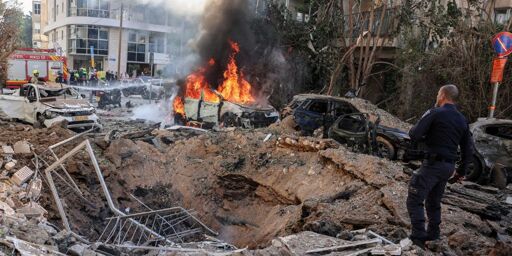
A month into the U.S. military campaign against Iran, Israel’s vaunted air defense system is showing its limits. Just in the past 10 days, major cities including Tel Aviv, Dimona, and Arad sustained significant damage when Iranian missiles successfully evaded Israel’s network of interceptors.
The most obvious explanation for the apparent failures is that depletion of Israel’s interceptor stockpiles is forcing the Israel Defense Forces to ration munitions or prioritize targets. But the faults in Israel’s air defenses almost certainly have deeper roots. After all, even if forced to defend only the most important locations, Israel would almost certainly place Dimona — a city located near several of Israel’s key nuclear facilities — at the top of the list.
The more worrisome reality is that gaps in Israel’s air defenses may be detection (rather than interception) failures resulting from damage to the radars and sensors that underlie the integrated air defense network shared by the United States, Israel, and Gulf partners. If true, the implications would be dire. Operating without the “eyes” that the American military relies on to identify and mitigate threats, U.S. forces and assets would be much more vulnerable than previously understood.
You must log in or # to comment.
It’s truly remarkable how badly this war is going for the US.
Competency is woke. This is the new leathal maga army. That’s not afraid to fuck up badly, as long as it felt right. And never accept responsibility or consequences. Responsibility and consequences are woke too.
Vibe warring.
Vibe Governing.
For the Greater Israel to become a superpower, not only does the Persian empire have to fall, but the American empire does as well.
Greater Israel is fully predicated on the US backstopping its existence, both politically and militarily.
Egypt, Jordan, Kuwait, Saudi Arabia, Turkiye, and now I guess Syria all align with Israel due to an enormous American boot on their collective necks. As soon as that weight is seen to lift up, you’re going to get a full blown Congolese War between the various tin pot dictators and aristocratic despots.
Israelis simply don’t have the manpower to control more territory. Their plans to settle the West Bank and Gaza are heavily predicated on damned near every Jew left on earth moving into their domain. And even then - so many of the Israel Jews hate one another, hate their Christian neighbors, hate their Arab co-conspirators, and hate their European financiers. This isn’t sustainable in any material way. Not without the world’s largest economy propping them up.
Israel only continues to exist because of US backing. If the US is unable to continue to supply Israel with money, arms, ammunition and to use it’s veto in the UN against any action the UN wants to take against Israel then Israel is done.
Fortunately for Israel, they own every branch of the US government, multiple three letter agencies, old school media, and new school media in the US, comedy(except for very few comedians) and music record labels throughout the US.
Going to enjoy reading this article every week for the next 20 years.
I’m starting to feel that the US military isn’t much more than a money pit.
Wealthy defense contractors would say otherwise, I’ll have you know.
Always has been, they regularly throw money at the Pentagon it doesn’t ask for or want.
The US military is optimised for curbstomp operations and surgical quick strikes
Something like this isn’t in the playbook at all.
The article’s headline isn’t supported by the text in the article.
The more worrisome reality is that gaps in Israel’s air defenses may be detection (rather than interception) failures resulting from damage to the radars and sensors that underlie the integrated air defense network shared by the United States, Israel, and Gulf partners. If true, the implications would be dire.
“May” and “if true” do not mean the radars that have been destroyed have changed the course of war as they claim in the headline.
I find it much more plausible that we’re simply seeing the effect of increased Iranian missile volume. Even if a system is successful 90% of the time, that’s still going to let through a lot of projectiles if the volume ramps up.
We’ve known for almost a month that two THAAD radars have been hit and that another was being pulled out of South Korea to act as a replacement. There’s also been drone footage of Iranian drones hitting radar installations.
I don’t see anything in the quoted text that contradicts the headline. Radar installations have been damaged, and these gaps may be a contributing factor to the reduction in interceptions.
This article has satellite images with before/after sliders of the two THAAD strikes.
Does the headline say “may” or does it make an explicit claim?
Nothing in the article contradicts the headline, true. There’s also nothing in the article supporting it.
It says:
Iran wipes out US-Israeli radars & sensors, changing course of war
…and yes, Iran wiped out two $1-billion THAAD raday systems (we only managed to make 8 since 2008), and many more smaller radars. We also just lost an E-3 sentry (for the first time as a combat loss, and we only had 16).
There’s plenty of significant evidence to support the headline, and it’s reasonable to come to the conclusion that these radar losses are contributing to the decrease in missle interceptions.
If a radar was down you’d see missing coverage over a relatively large area, not random missiles getting through here and there. No, I don’t think it’s a reasonable conclusion, I think it’s a bad article.
The large radars that were destroyed were used for early detection, they detected the missiles when they launched.
The antimissile defense systems have other smaller detection radars attached to them, but they only give them roughly 2 minutes of warning before impact. This doesn’t change their accuracy necessarily, but doesn’t give them enough time to vacate targets.
And most recently, it allows Iranian multi headed missiles to reach Israel airspace, and it doesn’t matter if the interceptors see it two minutes before landing because it splits into a hundred heads that are impossible to intercept.
It’s not just a matter of volume, Iran has been landing bigger payloads more often, a combination of no early detection and Israel running low on interceptors (that’s due to earlier volume attacks with the older missiles).
They also use cheap slow low flying drones that aren’t detected by the the radars at all. They’re easy to shoot down once detected, but they’re also harder to detect despite how slow, low, and loud they are. If they don’t have something ready to shoot them down and don’t see them until they get close to the target, they make it through.
Iran used older missiles to overwhelm the radars and anti-missile systems and hit them with drones while they were intercepting the missiles. They haven’t destroyed all of them, but they’ve destroyed plenty, and it does seem they’ve destroyed/heavily damaged most if not all the early detection radars in the region.
Where are you getting all that info? It isn’t in the article which is my entire point. Don’t mistake my criticism of the poorly written article as support of one side or the other.
https://apnews.com/article/iran-qatar-udeid-air-base-attack-us-aace65a65a0ce69090a7b65fe85cfac8
https://www.reuters.com/pictures/photos-show-aftermath-irans-waves-retaliatory-strikes-2026-03-30/
https://apnews.com/article/iran-war-us-troops-wounded-saudi-base-8404fd9b67b76c756e543fc307565572
There’s plenty more articles about different bases arrive the gulf and in Jordan being targeted and radars destroyed. You don’t need to just take this article’s statement at face value, but they also don’t need to directly cite a heavily reported reality in an article making a different point.
Keep in mind that the gulf have heavy censorship laws and have been arresting people for sharing footage, so we mostly see things from satellites after the fact.
And Israel is even worse on censorship, and you’ll find very little reporting on the hits they’re taking on MSM, but you can find plenty of footage on telegram and social media.
I don’t believe that’s accurate. The radar systems act as a mesh network, and if it’s patchy en route, it becomes harder to acquire a possible interception solution. This is especially the case when some of the longest range systems (such as THAAD) are out of commission. Then you need to rely on shorter range systems, such as Patriot missiles, with a shorter and lower intercept range. The article goes over this, and explains how the different systems act as multiple layers of air defense.
A loss of long-range radar and interception ability won’t look like a gaping hole with missiles flowing through. Instead, there will be more last-second attempts to shoot incoming missiles down, with a lower success rate than the long-range alternatives.
Damaging the radar does not make the THAAD system completely inoperable, experts say, as there are other assets and configurations, but it certainly degrades capability and flexibility.
Try again.
That’s not even in the article. The entire point I’m making is this is a poorly written article. Try again.
Here is an interesting satellite imagery analysis of the attacks done by Iran which shows some of the damage to the radars in the region.
Also, for low volumes, you may ripple multiple interceptors against single target. So if 1 interceptor has 90% chance of interception, 2 have 99%. But if you are worried about stockpiles, you may start firing just one to save your stockpiles. This is likely what we are seeing. This article is just a pile of horshit IMO.
Fuck yeah!
This reminds me of the fall of multiple fictional empires that had rested on their laurels building overpriced wonder weapons that turned out to both too few in number and not all that wonderous when taken out of a white room and exposed to real battlefield conditions.
Afghanistan…
US: “We’ve got the most sophisticated electronic warfare and counter intelligence systems in the world. We can intercept all their emails, cell phone and radio traffic.”
Taliban…goes back to using carrier pigeons and messengers on motorbikes carrying bits of paper.
the fall of multiple fictional empires
Appropriate, since we’re talking about Isn’trael.
So when Trump said they are “mostly defeated”, he was talking about the radar systems? It makes sense now.
“No they didn’t, they’re obliterated. We’re going to obliterate them again today.”
“I don’t think that world means what you think it means.”
Good. Keep up the good work.
Oopsie!
Seems like a rude thing for Iran to do
and dare i say, antisemitic?